
Why Borrowing Money for Casino Play Is Dangerous
For some people, the thought of borrowing money for casino play does not hit all at once. For another perspective on the money side of the topic, mino casino seriös may be useful. It creeps in after a stretch of losing that feels far longer than it actually was. After all, a person who walked through the doors of a casino fully aware they only had a set amount of money to risk can still find themselves gripping that reality tighter with each loss. In that moment of frustration, the idea of getting a little more money on short notice can seem like a way to fix the situation, and for that reason some will look into quick forms of credit such as without fully grasping that the goal has already changed from enjoying play to trying to claw back what is already gone. The moment borrowed money becomes the fuel for casino play, the entire thing is already starting to tilt against the person using it.
Once that line is crossed, the atmosphere of a casino takes on a different weight. When you are playing with money that you actually own, walking away stings but it is still your own choice. When you are playing with borrowed money, every loss carries two hits at the same time: the hit to your chances, and the hit to the fact that you now owe that money back no matter what happens next. The bright layout, the noise, and the constant flow around you were built to keep people playing, but for someone who already owes for their play, those things become far harder to ignore. Inside any casino, time has a way of stretching for those who are chasing, and with borrowed money on the table there is always the urge to buy just a bit more time with more borrowing. That urge is one of the clearest signs of how dangerous this path is becoming.
Balancing Money and Play
The real pull of borrowing money for casino play is not the hope of a massive payout, but the stubborn refusal to accept an empty balance. A person can rationalize walking back to a casino with borrowed money by telling themselves that if they just stay for a little while longer, the exact set of results will flip around to cover both their original spending and the new debt. The trouble is, a casino does not owe anyone that flip. Each round of play is its own outcome with no memory of the last one, and the more a person tries to force repayment through more play, the more likely they are to need more borrowed money to do it. At this point, the money is no longer a tool for a bit of play. It has become the reason to keep going, and keeping going is now tied to making a debt bigger with no guarantee of paying any of it off.
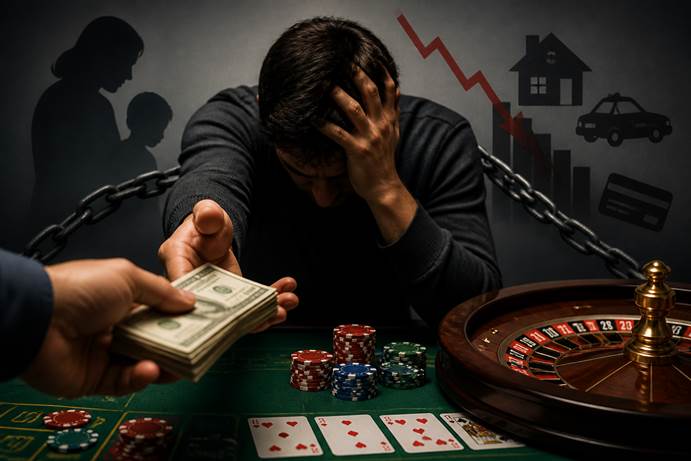
As debt starts to settle in away from the floor of the casino, the effects shift from the thrill of play to the weight of repayment. Bills that were easy to handle before now have to compete with money that was never meant for them. Even simple tasks begin to revolve around figuring out how to pay back what was taken just to gamble. The same person who only wanted one shot at breaking even inside that casino now finds their focus pulled away from rent, basic needs, or obligations they never wanted to put at risk. Borrowing money for casino play does not stay locked inside the casino walls once the night ends. It follows home with no flashing lights to distract from it, and unlike a lost bet, it does not disappear when you walk out of the casino for the last time that evening.
• The bright layout, the noise, and the constant flow around you were built to keep people playing, but for someone who already owes for their play, those things become far harder to ignore
• As debt starts to settle in away from the floor of the casino, the effects shift from the thrill of play to the weight of repayment
• The same person who only wanted one shot at breaking even inside that casino now finds their focus pulled away from rent, basic needs, or obligations they never wanted to put at risk
• Borrowing money for casino play does not stay locked inside the casino walls once the night ends
• It follows home with no flashing lights to distract from it, and unlike a lost bet, it does not disappear when you walk out of the casino for the last time that evening
• To pay off one round of borrowed money from casino play, more borrowing can seem like the quickest way out, even though it only adds more to the pile
• What started as an attempt to recover a small amount has the potential to stretch far past that with no natural stopping point built into it
• There is a harsh difference between choosing to stop playing when you run out of your own money, and being forced to keep thinking about money you owe because you ran out of your own and
Understanding Money
The longer this goes on, the harder it becomes to break the loop. To pay off one round of borrowed money from casino play, more borrowing can seem like the quickest way out, even though it only adds more to the pile. What started as an attempt to recover a small amount has the potential to stretch far past that with no natural stopping point built into it. There is a harsh difference between choosing to stop playing when you run out of your own money, and being forced to keep thinking about money you owe because you ran out of your own and chose to replace it with debt. Many people can walk away from a casino broke and frustrated, but far fewer are able to walk away easily once that break comes at the cost of borrowed money.
What to Know About Money
In the end, the danger of borrowing money for casino play lies less in any single loss and more in the process itself. It takes a normal want for play and twists it into a debt-driven need to play. A night that was only ever meant to use spare money can become a stretch of pressure that has nothing to do with fun anymore. The safest thing for anyone who ever feels that pull is to keep borrowed money far away from any casino, no matter how convincing the urge to recover becomes. Once that debt exists purely to feed more play, getting rid of it will always cost far more in stress than the money that was lost ever did in the first place.